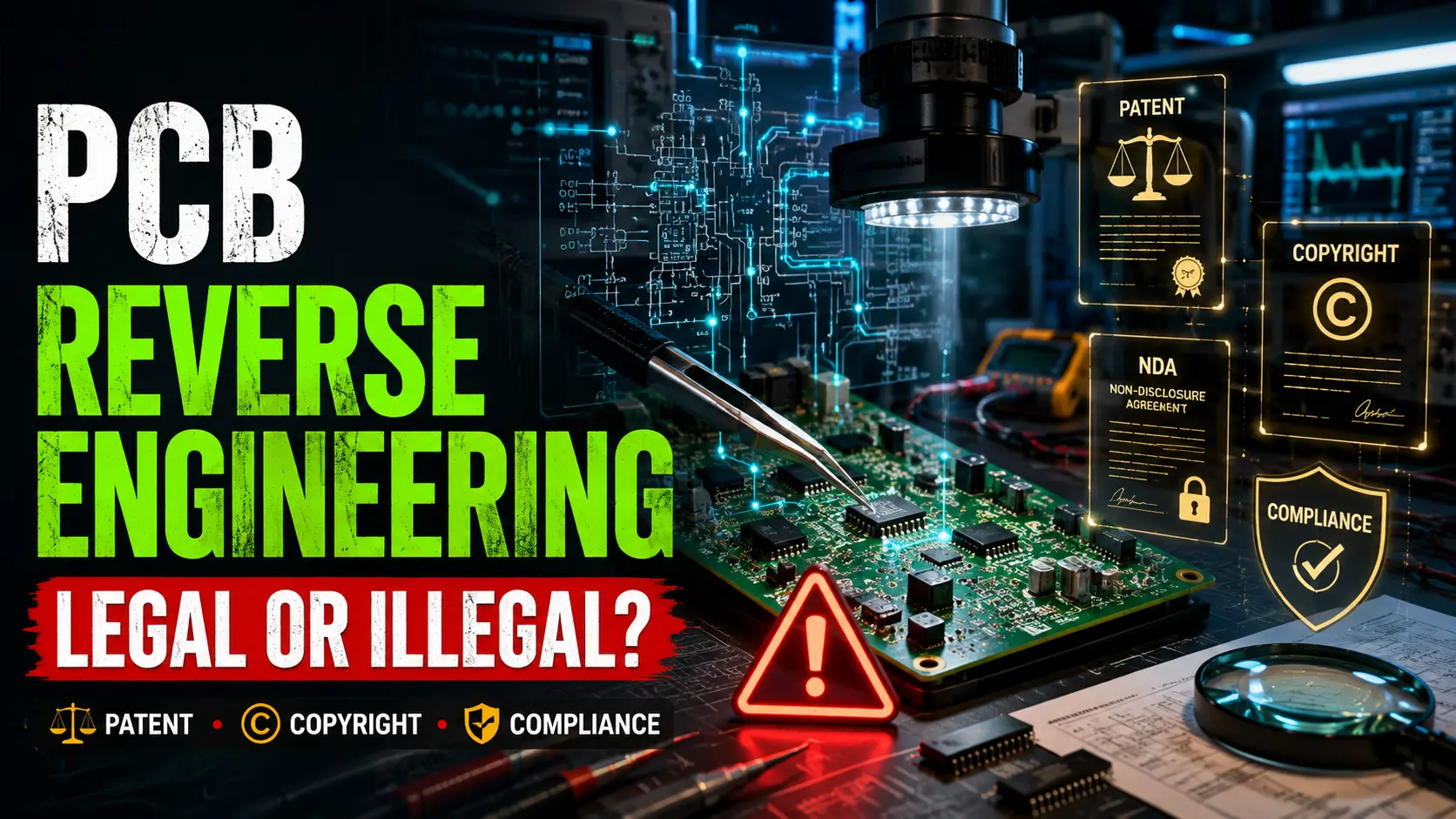
PCB reverse engineering usually begins as an engineering problem. A team may need to identify components, trace copper connections, rebuild a schematic, inspect firmware behavior, or understand why an older assembly has failed.
Before that work moves from analysis to redesign or production, however, there is another question to answer: Does the company have the right to perform the work, and how may the results be used?
In most commercial projects, PCB reverse engineering deserves a compliance review. That does not mean the activity is automatically prohibited. Examining a legitimately acquired product may be reasonable for failure analysis, maintenance, interoperability, quality verification, benchmarking, or support of obsolete equipment.
The risk depends on the source of the sample, the information being accessed, the purpose of the project, and what the company plans to do with the results.
This article focuses primarily on the U.S. legal framework. Requirements differ by jurisdiction, contract, product type, and intended market, so project-specific legal advice may still be necessary.
Analysis and Commercial Use Are Different Questions
The act of studying a circuit board is not always the main source of risk. In many cases, the more important issue is what happens after the technical work is complete.
U.S. trade secret guidance recognizes reverse engineering as a legitimate way to discover information when the product or sample was obtained lawfully. That is very different from using leaked Gerber files, stolen source code, internal factory documents, or information supplied in breach of an NDA.
Patent law works differently. A patent owner may prevent others from making, using, offering for sale, selling, or importing an invention covered by the patent. Independent development does not necessarily remove that risk. A company may acquire a product legally, analyze it without misappropriating a trade secret, and still face patent exposure if it later manufactures or sells a product that falls within an active patent claim.
That distinction is central to a compliance review:
- Understanding how an existing board works is one issue.
- Rebuilding, marketing, importing, or selling a similar product is another.
Patent Risk Depends on Claims, Not Appearance Alone
A reverse-engineered board does not have to be a perfect visual copy to create patent concerns. At the same time, two boards that look similar are not necessarily covered by the same patent.
The relevant question is whether the redesigned product falls within the scope of one or more valid patent claims. Those claims may cover a circuit function, control method, power architecture, connector arrangement, antenna structure, mechanical interface, or interaction between hardware and software.
A patent review becomes particularly important when the project is intended to produce:
- A replacement product for commercial sale
- A near-identical alternative to an existing board
- A product that performs the same function using the same technical approach
- A board intended for import into a market where relevant patents remain active
A basic keyword search is not the same as a freedom-to-operate analysis. The review should consider the applicable countries, patent status, claim language, ownership, expiration dates, and whether a practical design-around is available.
The Source of the Information Matters
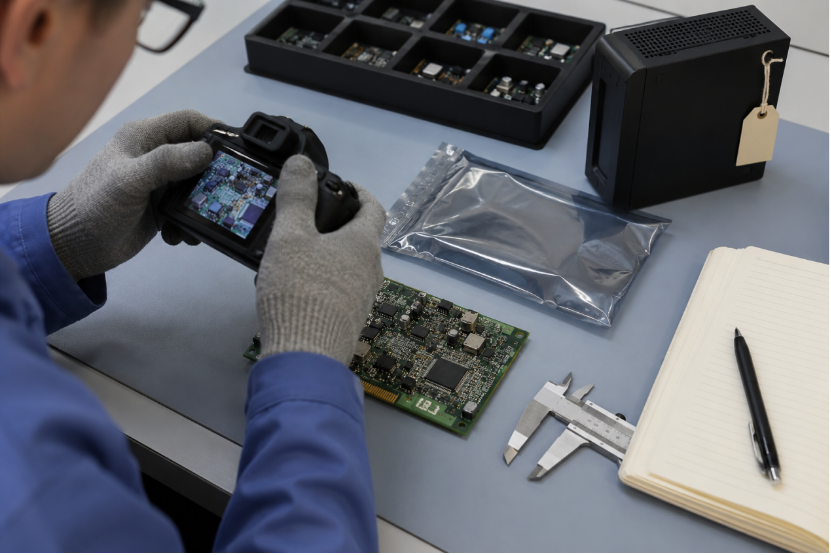
Trade secret risk often depends less on the circuit itself than on how the team obtained the information.
A purchased product that is available on the open market is different from:
- A customer sample supplied under limited evaluation terms
- Gerber files obtained from a former employee
- Internal test procedures copied from another manufacturer
- Supplier data shared without authorization
- Firmware or source code covered by a confidentiality agreement
A physical board does not automatically grant rights to every related file, manufacturing record, test method, or software component.
The project file should therefore record where the sample came from, who owns it, whether any NDA or supply agreement applies, and what the customer has authorized the engineering team to do. That record is especially important when several companies are involved, such as an OEM, contract manufacturer, repair provider, distributor, and end customer.
Firmware Creates a Separate Copyright and Access-Control Issue
Modern PCB analysis often extends beyond components and copper. Engineers may need to examine bootloaders, configuration memory, device drivers, communication protocols, encryption routines, or embedded firmware.
Those activities can raise two separate questions.
The first is whether copying, modifying, or distributing the software is permitted under copyright law or the applicable license.
The second is whether the work requires bypassing an access-control mechanism. Section 1201 of the U.S. Digital Millennium Copyright Act generally prohibits circumvention of technological measures that control access to copyrighted works. The U.S. Copyright Office administers temporary exemptions through a recurring rulemaking process, but those exemptions are limited to defined activities and classes of works. They do not create a general right to bypass any protection encountered during hardware analysis.
Reading an unprotected memory device is therefore not the same compliance question as defeating encryption, disabling secure boot, extracting protected code, or distributing a tool designed to bypass access controls.
The firmware scope should be reviewed before extraction begins, not after protected code has already been copied.
Contracts May Be More Restrictive Than General IP Rules
Even when reverse engineering may be permitted under general intellectual property principles, contractual terms can change the position.
Restrictions may appear in:
- Nondisclosure agreements
- Product evaluation agreements
- Software licenses
- Supply contracts
- Prototype or sample agreements
- Development agreements
- Customer purchase terms
- Online terms accepted when software or documentation was downloaded
The enforceability and interpretation of those provisions can vary by jurisdiction and circumstances. Still, ignoring them creates unnecessary risk.
A compliance review should identify which contracts apply to the sample, software, documentation, and intended use of the resulting design. It should also determine whether the customer actually has the authority to authorize the requested work.
Regulatory Approval Does Not Transfer With the Circuit
A reverse-engineered board may operate correctly on the bench and still be unsuitable for commercial release.
Reproducing the hardware does not automatically reproduce the validation history, change records, safety analysis, traceability, test evidence, or regulatory approval associated with the original product.
Medical devices provide a clear example. FDA guidance states that design changes should undergo verification, validation, or other evaluation, and a significant change to a device’s design, components, manufacturing method, or intended use may require a new 510(k) submission.
Radio-frequency products create a similar issue. Hardware or circuitry changes can affect the equipment authorization basis. FCC rules distinguish between permitted changes and modifications that require a new application or supporting test data. A replacement PCB should not be assumed to remain covered by the original authorization simply because it fits the same enclosure or performs the same general function.
The same principle applies more broadly: certification status must be assessed against the redesigned product, not borrowed from the product that was analyzed.
Where Compliance Fits Into the Engineering Work
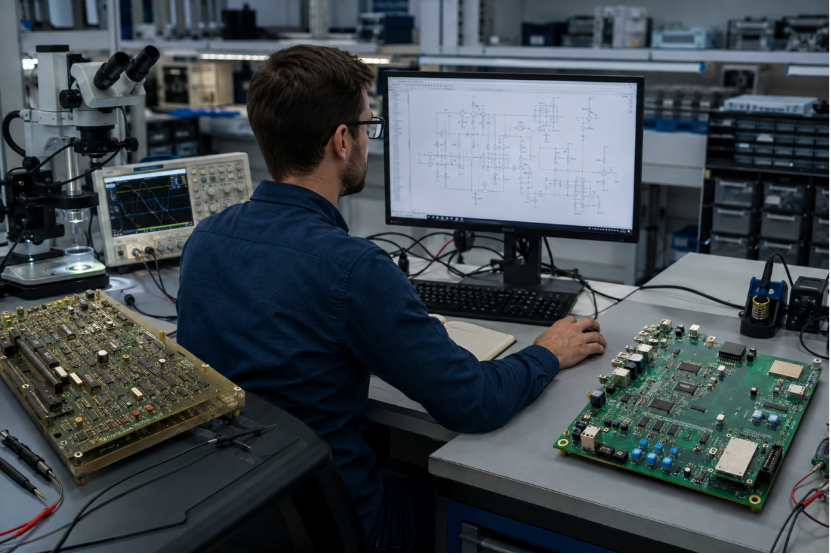
Compliance should be built into the reverse engineering process rather than added after a prototype has already been completed.
At the beginning of the project, the team should document the sample’s origin, ownership, contract status, and intended use. That first review determines whether the board may be opened, photographed, sectioned, tested, or sent to an outside laboratory.
During non-destructive analysis, engineers may record component markings, layer construction, dimensions, interfaces, and electrical behavior. If the project then moves into destructive inspection, firmware extraction, schematic reconstruction, or material analysis, the authorized scope should be checked again.
Before producing a prototype, the company should decide whether the output is:
- A maintenance drawing for an existing asset
- A functional replacement for obsolete equipment
- A redesigned product using independently selected architecture
- A direct commercial substitute for the original
- A test fixture or diagnostic tool
- A manufacturing-ready clone
Those outputs carry different levels of risk. The decision should be documented before the reconstructed design is quoted or released for fabrication.
Projects That Are Generally Easier to Defend
Some reverse engineering projects have a clearer operational purpose and do not begin with the goal of copying a competing product.
Common examples include:
- Diagnosing a failed or undocumented assembly
- Maintaining equipment whose original supplier no longer supports it
- Developing a compatible replacement for an unavailable component or interface
- Verifying the quality or construction of an incoming product
- Studying a product to inform an independently developed redesign
- Reconstructing documentation for equipment already owned by the company
- Comparing performance, materials, or manufacturing methods during benchmarking
These purposes do not eliminate patent, contract, copyright, or regulatory questions. They do, however, provide a more defensible business context than a project whose stated objective is to reproduce another company’s product as closely and cheaply as possible.
Warning Signs That Call for Closer Review
The compliance risk becomes more serious when a project includes several of the following features:
- The customer requests a one-to-one copy with no design changes.
- The new product will directly replace the original in the same market.
- Design files come from a former employee, supplier, or customer without a clear authorization trail.
- The project requires bypassing encryption, secure boot, or protected firmware access.
- The customer asks the manufacturer to remove identifying marks or conceal the product’s origin.
- The board belongs to a regulated product, but no new validation or certification work is planned.
- The customer claims ownership but cannot provide supporting documentation.
- The project requires copying test procedures, calibration data, or software that was not obtained with the physical product.
None of these points proves that a project is unlawful. They indicate that engineering work should pause until the ownership, authorization, and intended use are clearer.
A Practical Review Before Work Begins
A short pre-project review can prevent a large amount of unnecessary work later.
Was the sample obtained lawfully?
Record how it was purchased or transferred, who owns it, and whether the person requesting the work has authority over it.
What is the actual objective?
“Understand the failure” is different from “manufacture a commercial replacement.” The objective should be specific enough to guide both engineering and legal review.
Which outputs are required?
Define whether the team will produce photographs, a BOM, netlist, schematic, PCB layout, firmware analysis, prototype, test report, or production package.
Are protected files or software involved?
Identify whether the project will require access to encrypted memory, licensed software, customer documents, source code, or confidential manufacturing data.
Could the resulting product fall within an active patent?
The answer may require a claim-level review in every country where the product will be manufactured, imported, or sold.
Do any contracts restrict the work?
Review NDAs, licenses, evaluation terms, supply agreements, and development contracts before relying on the physical possession of a sample.
Will the redesign affect a regulated product?
Determine whether new verification, validation, EMC testing, safety testing, documentation, or market authorization will be required.
Can independent engineering decisions be documented?
Records of alternative components, redesigned circuits, new calculations, test results, and design reviews can help distinguish an independent redesign from uncontrolled copying.
When a project is handed to PCBCool or any other manufacturing partner, the documentation should clearly identify who controls the sample, what work has been authorized, and how the resulting files and products may be used. A manufacturer should not be expected to infer those rights from the presence of a physical circuit board.
Final Thoughts
PCB reverse engineering is not inherently non-compliant, nor is legal ownership of a sample enough to answer every question.
A responsible project connects technical investigation with a clear record of authorization, purpose, and intended use. That discipline does more than reduce legal exposure. It gives engineers better boundaries, prevents unnecessary redesign work, and creates a decision trail that customers, manufacturers, and regulators can understand.
The best outcome is not simply a board that works. It is a design whose technical origin, commercial use, and compliance position can all be explained without ambiguity.